HIFU Treatment in Dubai: Non-Invasive Skin Lifting, Tightening & Facial Contouring at JMED Clinic
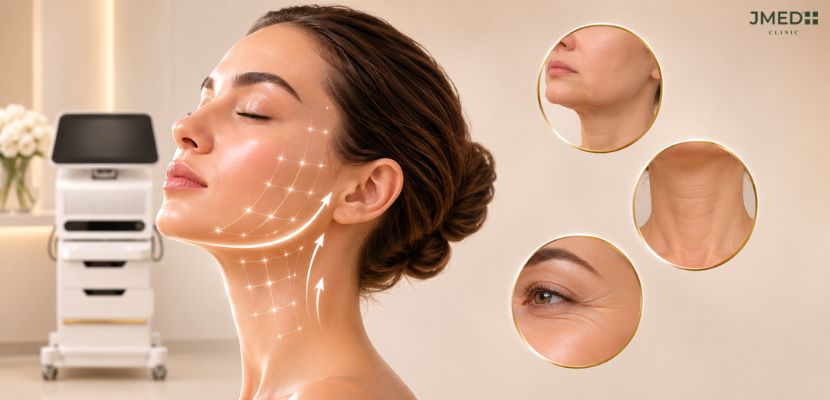
Introduction: Restore Skin Firmness Without Surgery
As the skin ages, it gradually loses collagen, elastin and some of the structural support responsible for keeping it firm, smooth and lifted. These natural changes can become visible as sagging cheeks, a softer jawline, loose skin around the neck, fine lines and reduced facial definition. Similar changes can also affect the body, particularly after weight fluctuations or as skin elasticity decreases over time.
For people who want to improve skin firmness without undergoing surgery, HIFU treatment offers a non-invasive approach to skin lifting and tightening. High-Intensity Focused Ultrasound (HIFU) uses concentrated ultrasound energy to target selected tissue depths beneath the skin, supporting the body’s natural collagen-remodelling response.
At JMED Clinic Dubai, LIFTHERA™ is an advanced HIFU technology designed for face and body lifting. It delivers focused ultrasound energy at selected depths to address concerns such as facial laxity, a less-defined jawline, neck looseness, wrinkles and selected areas of loose body skin. The treatment is planned according to the individual’s skin condition, treatment area and desired outcome.
Rather than changing the natural character of the face, the aim of HIFU skin tightening is to support a firmer, more refreshed and better-defined appearance through a non-surgical treatment approach.
HIFU treatment is a non-invasive skin lifting procedure that uses High-Intensity Focused Ultrasound energy to target selected layers beneath the skin. The controlled thermal response supports collagen remodelling, helping improve skin firmness, facial definition and the appearance of laxity. At JMED Clinic Dubai, LIFTHERA™ offers customised HIFU treatments for the face, neck and selected body areas.
What Is HIFU Treatment?
HIFU stands for High-Intensity Focused Ultrasound. It is a non-surgical aesthetic technology that delivers concentrated ultrasound energy to specific depths beneath the skin. The purpose is to create a controlled thermal response in the targeted tissue, encouraging the body’s natural regenerative processes and supporting collagen renewal.
Unlike treatments that work mainly on the skin’s surface, HIFU is designed to reach deeper tissue layers while leaving the epidermal surface intact. This makes it a non-ablative treatment approach: the surface of the skin is not intentionally removed, and there are no surgical incisions.
Collagen is an essential structural protein that helps the skin maintain firmness, elasticity and support. As collagen production naturally declines with age, the skin may gradually become less firm. HIFU aims to support the remodelling process that contributes to a tighter and more lifted appearance.
How Does HIFU Work Beneath the Skin?
HIFU technology uses focused ultrasound energy rather than relying on surface exfoliation or surgical lifting. The energy is delivered to selected depths according to the treatment area and the individual’s needs.
The process can be understood in four stages:
- Focused ultrasound delivery: The device delivers concentrated ultrasound energy to selected tissue depths beneath the skin.
- Controlled thermal response: The focused energy creates heat within the targeted tissue, producing a controlled response.
- Natural regenerative activity: The treated tissue responds through the body’s natural repair and regeneration processes.
- Collagen remodelling: Over time, collagen remodelling can support improved firmness and a more lifted appearance.
The results develop progressively rather than appearing immediately as they would with a surgical procedure. The degree of improvement depends on the individual’s skin condition, level of laxity, treatment area and natural response.
What Makes LIFTHERA™ Different at JMED Clinic?
JMED Clinic uses LIFTHERA™, an advanced HIFU technology for non-surgical face and body lifting. Its treatment approach is based on delivering focused ultrasound energy at selected depths to address different tissue and treatment-area requirements.
The technology offers multiple treatment depths, allowing the protocol to be adapted for facial and body areas. This is important because the skin and underlying tissue around the eyes, cheeks, jawline, neck and abdomen do not have identical treatment requirements.
At JMED Clinic, the treatment is not selected simply because someone wants a facelift effect. The practitioner first considers the location and degree of skin laxity, skin quality, facial proportions and the individual’s expectations. The treatment plan is then tailored to the areas that may benefit from HIFU.
What Causes Skin Sagging and Loss of Firmness?
Skin laxity is a gradual process influenced by several internal and external factors. Although ageing is one of the most common reasons, it is not the only cause. Understanding why the skin becomes loose can help determine whether HIFU treatment is an appropriate option.
1. Natural Ageing and Reduced Collagen Production
Collagen and elastin help maintain the skin’s structure, firmness and flexibility. As the body ages, the production and organisation of these proteins change. The skin may gradually lose some of its natural support, making sagging and wrinkles more noticeable.
This can appear as reduced cheek firmness, deeper folds, a softer jawline or loose skin around the neck. HIFU skin tightening is designed to support collagen remodelling in selected tissue layers.
2. Reduced Skin Elasticity
Elastin contributes to the skin’s ability to stretch and return to its original position. With age and cumulative environmental exposure, the skin may become less elastic.
When elasticity decreases, the skin may not recover as easily from stretching or changes in volume. This can contribute to looseness around the lower face, neck, arms and abdomen.
3. Weight Fluctuations
Significant weight gain and subsequent weight loss can affect the appearance of the skin. When the body changes in size, the skin stretches to accommodate those changes. Depending on the amount of weight change, age and natural elasticity, some areas may not return to their previous firmness.
HIFU may be considered for selected areas of loose skin, but it should not be confused with a weight-loss or fat-reduction procedure.
4. Sun Exposure and Environmental Stress
Long-term exposure to ultraviolet radiation can contribute to changes in collagen and elastin. Environmental stressors may also affect the overall appearance and quality of the skin.
Sun protection and a consistent skincare routine are important for maintaining skin health, even when professional lifting treatments are being considered.
5. Changes in Facial Volume and Structure
Facial ageing is not caused by skin laxity alone. Changes in underlying fat distribution, facial volume and supporting structures can also affect the appearance of the cheeks, jawline and lower face.
This is why an appropriate treatment assessment matters. HIFU may help address certain concerns related to skin firmness, but it does not replace every treatment used for volume loss or other structural changes.
6. Pregnancy and Body Changes
Pregnancy and other significant body changes can affect the skin’s firmness, particularly around the abdomen. Changes in skin elasticity and stretching may leave some areas looking less firm.
For suitable clients, body HIFU may be considered as part of an individualised approach to selected areas of loose skin. A professional assessment is necessary to establish suitability and appropriate timing.
What Areas Can HIFU Treatment Target?
One of the advantages of LIFTHERA™ at JMED Clinic is its face-and-body treatment approach. Different areas can be assessed according to their anatomy, skin condition and degree of laxity.
HIFU Face Treatment
HIFU face treatment is designed to address concerns related to facial skin laxity and reduced firmness. It may be considered for people who notice that their cheeks, lower face or overall facial contours look less defined.
Treatment areas may include:
- Cheeks and mid-face
- Lower face
- Jawline
- Neck
- Selected areas around the eyes, depending on suitability
The objective is to support a firmer-looking appearance while maintaining natural facial proportions. A personalised treatment plan helps determine which areas should be targeted and whether HIFU is appropriate.
HIFU Jawline Tightening
A softer jawline is a common concern as skin firmness changes with age. The lower face may begin to look less defined, and the transition between the chin and neck may become less distinct.
HIFU jawline treatment targets selected tissue depths in the relevant area. By supporting collagen remodelling, it may help improve the appearance of firmness and definition.
However, a less-defined jawline can have several causes, including skin laxity, fat distribution and bone structure. HIFU is not a substitute for every jawline-contouring procedure, so an assessment is important before treatment.
HIFU Double Chin Area
The appearance of a double chin may be related to fat distribution, skin laxity, genetics or a combination of factors. HIFU may be considered when reduced skin firmness contributes to the appearance of the area.
It is important to understand that skin tightening and fat reduction are different treatment goals. LIFTHERA™ is presented by JMED Clinic as a skin lifting and tightening technology. Whether it is suitable for a particular double-chin concern depends on the underlying cause and individual assessment.
HIFU Neck Treatment
The neck can show visible signs of ageing, including fine lines, loose skin and reduced firmness. Since the skin in this area has different characteristics from facial skin, treatment planning needs to take the neck’s anatomy into account.
HIFU neck treatment may be used to target selected areas of laxity and support a firmer-looking appearance. At JMED Clinic, the treatment approach is selected according to the individual’s concerns and suitability.
HIFU Body Treatment
HIFU is not limited to facial rejuvenation. LIFTHERA™ also offers treatment options for selected body areas where deeper treatment settings may be appropriate.
At JMED Clinic, potential treatment areas include:
- Abdomen: For selected areas of loose skin and reduced firmness.
- Inner arms: For skin that has become less firm with age or body changes.
- Knees: For localised skin laxity around the knee area.
- Buttocks: For selected concerns involving skin firmness and contour appearance.
Body treatment is planned according to the area, skin condition and available treatment depths. HIFU should not be presented as a replacement for weight management, exercise or surgical procedures when these are clinically indicated.
Types of HIFU Treatment: Face, Neck and Body Approaches
HIFU is one technology category, but treatment planning differs depending on the area being treated. A face protocol and a body protocol cannot simply be treated as identical procedures.
1. HIFU Facial Lifting
HIFU facial lifting focuses on selected facial areas where skin laxity and reduced firmness are concerns. The treatment may include the cheeks, lower face and other suitable areas.
The aim is to support collagen remodelling and improve the appearance of facial firmness without surgery. It is particularly relevant for people who want a gradual, natural-looking improvement rather than a dramatic surgical change.
2. HIFU Neck Tightening
This approach focuses on selected areas of the neck where skin looseness and reduced elasticity may be visible. Treatment planning should account for the neck’s anatomy and the individual’s skin condition.
The objective is to improve the appearance of firmness while keeping the treatment non-invasive.
3. HIFU Jawline and Lower-Face Lifting
The lower face is often one of the first areas where changes in definition become noticeable. HIFU can be considered for selected cases where skin laxity contributes to a softer jawline.
Treatment is planned to address the individual’s concern without assuming that every less-defined jawline has the same cause.
4. HIFU Body Skin Tightening
Body HIFU focuses on selected areas of skin laxity, such as the abdomen, inner arms, knees and buttocks. The treatment depth and protocol are chosen according to the area being addressed.
A consultation helps establish whether HIFU is suitable or whether another approach would better match the concern.
Why Does Early Skin Tightening Matter?
Skin laxity generally develops gradually. Many people first notice subtle changes, such as a softer jawline, less-defined cheeks or slight looseness around the neck. These changes may become more noticeable over time as collagen and elastin continue to change.
Considering treatment when the initial signs appear can help people explore non-surgical options before laxity becomes more pronounced. It also allows a practitioner to assess whether a treatment such as HIFU is appropriate for the individual’s current skin condition.
However, early treatment does not mean everyone needs HIFU at a young age. Preventive aesthetic procedures should never be treated as a requirement. The decision should be based on actual skin concerns, suitability and realistic expectations.
A professional consultation can help answer three important questions:
- Is the concern primarily related to skin laxity?
- Is HIFU likely to address the specific concern?
- Would another treatment or combination of approaches be more appropriate?
At JMED Clinic, this assessment forms an important part of planning a personalised LIFTHERA™ treatment.
Best HIFU Treatments and Skin-Lifting Solutions at JMED Clinic Dubai
Choosing a skin-lifting treatment involves more than selecting a device. The technology, treatment depth, area being treated and practitioner’s understanding of skin anatomy all contribute to the overall approach.
At JMED Clinic Dubai, LIFTHERA™ is used as an advanced HIFU option for non-surgical face and body lifting. Its multiple treatment depths allow the protocol to be adapted to different areas rather than applying one standard approach to every concern.
1. LIFTHERA™ HIFU for Facial Rejuvenation
For clients experiencing facial laxity, LIFTHERA™ may be used to target selected areas such as the cheeks, lower face and jawline. The focused ultrasound energy works beneath the skin to create a controlled thermal response, supporting the body’s natural collagen-remodelling process.
The treatment is intended to help improve the appearance of firmness and facial definition. It does not involve surgical incisions or deliberate removal of the skin’s surface.
At JMED Clinic, facial treatment planning takes into account the individual’s natural facial structure. This is important because the aim of a non-surgical HIFU facelift is not to create an artificial or over-tightened appearance. It is to support a refreshed look while respecting the client’s existing features.
2. LIFTHERA™ for Jawline Definition
A well-defined jawline contributes to the overall balance of the face. When skin around the lower face begins to lose firmness, the jawline can appear softer.
LIFTHERA™ may be used to address selected areas around the lower face and jawline. Focused ultrasound energy is delivered at appropriate depths to support collagen remodelling and improve the appearance of firmness.
The treatment is particularly relevant when skin laxity is a contributing factor. If the concern is primarily caused by fat distribution, skeletal structure or significant excess skin, another treatment approach may be more suitable.
This is why JMED Clinic’s assessment is important before proceeding.
3. LIFTHERA™ for Neck Firmness
The neck can develop visible looseness and lines as skin elasticity changes. Since this area has different anatomical characteristics from the face, it requires appropriate treatment planning.
LIFTHERA™ may be considered for selected neck areas where improved firmness is the treatment goal. The protocol is adapted to the individual’s skin condition and the area being treated.
The objective is a gradual improvement in the appearance of skin firmness, not an instant surgical-style result.
4. LIFTHERA™ for Body Skin Tightening
Loose body skin can occur after weight changes, pregnancy or natural ageing. Some clients notice reduced firmness around the abdomen, inner arms, knees or buttocks.
LIFTHERA™ offers selected body treatment options using appropriate treatment depths. The practitioner assesses the area and determines whether HIFU is a suitable approach.
It is important to distinguish body skin tightening from body slimming. HIFU skin tightening is intended to address concerns related to firmness and laxity; it should not be described as a guaranteed method of weight loss or significant fat reduction.
5. A Personalised Treatment Plan
The best treatment is not necessarily the one with the most aggressive settings or the greatest number of treated areas. A suitable protocol should reflect the individual’s anatomy, skin condition, concerns and expectations.
At JMED Clinic, treatment planning considers:
- The location and degree of skin laxity.
- Whether the concern is facial, neck-related or body-related.
- The selected treatment depth and area.
- The client’s skin condition and treatment history.
- Whether HIFU is appropriate as a standalone treatment or another approach should be considered.
This individualised process helps ensure that the treatment recommendation is based on the client’s needs rather than a standard package.
Thinking about a non-surgical facelift in Dubai? Book your consultation at JMED Clinic to explore whether LIFTHERA™ HIFU is suitable for your face, neck or body concerns.
What Happens During a HIFU Treatment at JMED Clinic?
Understanding the treatment process can help clients feel more confident before their appointment. Although the exact protocol depends on the treatment area and individual requirements, the general process involves consultation, assessment, treatment planning and focused ultrasound delivery.
Step 1: Consultation and Skin Assessment
The process begins with a consultation to understand the client’s concerns and treatment goals. The practitioner assesses the areas where looseness or reduced firmness is visible and discusses the client’s expectations.
This step is important because not every concern is caused by skin laxity. For example, a less-defined jawline may be related to skin changes, fat distribution or facial anatomy. Identifying the main concern helps determine whether HIFU is an appropriate option.
Step 2: Selecting the Treatment Area
Once suitability has been assessed, the practitioner identifies the areas that may benefit from treatment. These may include the lower face, cheeks, jawline, neck or selected body areas.
The treatment area is chosen according to the client’s needs rather than assuming that a full-face or full-body procedure is necessary.
Step 3: Choosing the Appropriate Treatment Depth
LIFTHERA™ offers different treatment depths to accommodate different areas and tissue requirements. The appropriate setting is selected according to the treatment area and individual assessment.
Facial and body areas require different considerations. The treatment plan should therefore be adapted rather than using the same settings everywhere.
Step 4: Delivering Focused Ultrasound Energy
During treatment, the device delivers focused ultrasound energy to the selected tissue depths. This creates a controlled thermal response beneath the skin while keeping the epidermal surface intact.
The treatment is non-invasive and non-ablative. There are no surgical incisions, and the skin’s surface is not removed.
Step 5: Aftercare and Follow-Up
After the treatment, the practitioner provides guidance based on the client’s skin condition and the procedure performed. Clients should follow the clinic’s instructions and contact the clinic if they experience unexpected or concerning symptoms.
The practitioner may also discuss when to review the treated area and how to assess the developing results.
How Long Does HIFU Treatment Take?
According to the LIFTHERA™ treatment information supplied by JMED Clinic, a full face and neck procedure typically takes approximately 40–60 minutes.
The exact duration may vary depending on the treatment area, the extent of coverage and the individual treatment plan. A smaller area may require a different amount of time from a combined face-and-neck procedure.
During the consultation, the clinic can explain the expected appointment duration and the areas included in the proposed protocol.
At-Home Skin Tightening vs Professional HIFU Treatment
Skincare products, facial massage and professional aesthetic procedures can all play a role in a skin-care routine, but they do not work in the same way.
Understanding the difference helps set realistic expectations and prevents confusion between everyday skincare and treatments designed to target deeper tissue layers.
What Can At-Home Skincare Do?
At-home skincare is essential for maintaining the skin’s surface condition and supporting long-term skin health. A consistent routine may help improve hydration, texture and the appearance of fine lines.
Useful skincare habits include:
- Daily sunscreen: Helps protect the skin from ultraviolet exposure, which contributes to premature ageing.
- Moisturising: Supports skin hydration and helps maintain a smoother appearance.
- Appropriate active ingredients: Ingredients such as retinoids, when suitable and professionally advised, may support improvements in skin texture and signs of ageing.
- Gentle cleansing: Helps maintain the skin barrier without unnecessary irritation.
- Consistent skincare: Regular habits are generally more useful than frequently changing products.
However, topical skincare does not deliver focused ultrasound energy to deeper tissue layers. It should not be expected to produce the same treatment response as professional HIFU.
What Does Professional HIFU Offer?
Professional HIFU treatment is designed to target selected tissue depths beneath the skin using focused ultrasound energy. It creates a controlled thermal response that supports the body’s natural collagen-remodelling process.
At JMED Clinic, LIFTHERA™ provides a structured face-and-body approach with multiple treatment depths. This allows the practitioner to plan treatment according to the area and the individual’s skin condition.
Which Option Is Better?
At-home skincare and professional HIFU are not direct alternatives. They serve different purposes.
| At-home skincare | Professional HIFU |
| Supports everyday skin health | Targets selected tissue depths beneath the skin |
| Helps maintain hydration and surface texture | Supports collagen remodelling |
| Requires consistent daily use | Performed as a professional aesthetic procedure |
| Does not provide focused ultrasound energy | Uses focused ultrasound energy |
| Helps maintain skin quality | May improve the appearance of skin firmness and laxity |
For many clients, a combination of good daily skincare and an appropriate professional treatment plan offers a more complete approach to skin maintenance.
HIFU Treatment Results: Timeline and Expectations
One of the most important things to understand about HIFU treatment is that results are progressive. The procedure is designed to support the body’s natural regenerative response, so the appearance of the treated area can change over time.
Immediately After Treatment
Some clients may notice an initial feeling of firmness or changes in how the treated area looks. However, immediate appearance should not be considered the final result.
The treatment’s main objective is to support a process of collagen remodelling that develops over time.
Following Weeks and Months
As the treated tissue responds, collagen remodelling may contribute to gradual improvements in firmness and definition. The timing and degree of change vary between individuals.
Factors that influence results include:
- Age and natural collagen levels.
- Existing skin laxity.
- The area being treated.
- Skin condition and tissue characteristics.
- The selected treatment protocol.
- The individual’s biological response.
How Long Do HIFU Results Last?
The duration of results varies. Natural ageing continues after treatment, and factors such as sun exposure, lifestyle and changes in skin condition can influence how long improvements remain noticeable.
During consultation, JMED Clinic can discuss realistic expectations based on the individual’s concerns and treatment area. No fixed duration or identical outcome should be promised to every client.
Is HIFU Treatment Safe? Understanding Suitability and Aftercare
HIFU is a non-invasive treatment, but that does not mean it is automatically suitable for everyone. The technology delivers focused energy beneath the skin, so appropriate assessment, treatment planning and professional application are essential.
Before treatment, clients should discuss their medical history, current skin condition, previous aesthetic procedures, medications and any concerns with the practitioner. The practitioner can then determine whether HIFU is appropriate or whether another option should be considered.
Clients should also understand that non-invasive treatments can still involve temporary reactions or discomfort. The exact experience varies according to the individual and treatment area. The clinic should explain expected effects and the signs that require follow-up.
After treatment, clients should follow the clinic’s personalised instructions. They should avoid introducing unnecessary or irritating products if advised, protect their skin from excessive sun exposure and contact the clinic if they experience unexpected symptoms.
A responsible treatment plan prioritises suitability and realistic expectations rather than promising a particular degree of lifting.
Common Myths vs Facts About HIFU Treatment
There is considerable interest in non-surgical facelifts, but some misconceptions can create unrealistic expectations. Understanding the facts helps clients make informed decisions.
Myth 1: HIFU Gives the Same Result as a Surgical Facelift
Fact: HIFU is a non-invasive skin-lifting treatment, not a surgical facelift. It may improve the appearance of mild to moderate skin laxity in suitable clients, but it cannot reproduce the results of surgery for significant excess skin.
Myth 2: HIFU Results Are Always Immediate
Fact: HIFU supports collagen remodelling, which develops progressively. Some people may notice an early change, but the overall result should be assessed over time rather than immediately after the appointment.
Myth 3: HIFU Is Only for the Face
Fact: HIFU technologies can be used for selected body areas as well as the face. At JMED Clinic, LIFTHERA™ treatment options include areas such as the abdomen, inner arms, knees and buttocks, subject to individual suitability.
Myth 4: HIFU Is a Weight-Loss Treatment
Fact: HIFU skin tightening and weight loss are different goals. LIFTHERA™ is presented as a lifting and tightening technology. It should not be treated as a substitute for weight management or a guaranteed fat-reduction procedure.
Myth 5: Everyone Needs the Same HIFU Settings
Fact: Treatment depth and protocol should be selected according to the treatment area and individual tissue requirements. A personalised assessment is essential.
Myth 6: Non-Invasive Means No Assessment Is Needed
Fact: Even non-invasive aesthetic procedures require appropriate screening. A practitioner should assess the client’s skin condition, medical history and treatment goals before recommending HIFU.
Myth 7: HIFU Stops the Ageing Process
Fact: HIFU does not stop natural ageing. It may support improvements in skin firmness, but collagen and elastin continue to change over time. Long-term skin care and realistic maintenance expectations remain important.
Expert Tips for Better Skin Firmness and Long-Term Skin Health
Professional treatments are only one part of maintaining healthy-looking skin. Everyday habits can help support the skin and maintain its overall appearance.
1. Protect Your Skin from Sun Exposure
Daily broad-spectrum sunscreen is one of the most useful habits for preventing premature skin ageing. Sun exposure can contribute to changes in collagen and elastin, so protecting exposed areas of the face, neck and body is important.
2. Maintain a Consistent Skincare Routine
A suitable skincare routine should focus on cleansing, moisturising and sun protection. Additional ingredients can be introduced according to skin type and professional advice.
Consistency is more important than using a large number of products.
3. Maintain Stable Lifestyle Habits
Adequate sleep, balanced nutrition, hydration and regular physical activity contribute to overall wellbeing and support healthy skin maintenance.
Although these habits cannot replace professional treatment, they form an important foundation for long-term skin health.
4. Avoid Choosing Treatments Based Only on Trends
A treatment that is popular online may not be appropriate for every individual. The right procedure depends on the concern being treated, the client’s anatomy, skin condition and expectations.
A professional consultation helps distinguish between treatments for skin laxity, volume loss, pigmentation, wrinkles and other concerns.
5. Choose a Clinic That Prioritises Assessment
The quality of the treatment experience depends on more than the technology name. A clinic should explain how the treatment works, what it can realistically achieve, who may benefit and what alternatives exist.
At JMED Clinic, the LIFTHERA™ approach begins with an individual assessment so that treatment areas and protocols can be selected according to the client’s needs.
Why Choose JMED Clinic for HIFU Treatment in Dubai?
Choosing a clinic for HIFU treatment is an important decision. Clients should look for a provider that understands skin ageing, uses appropriate technology and develops a treatment plan around individual needs rather than offering a standard procedure to everyone.
JMED Clinic Dubai focuses on advanced skin regeneration and aesthetic treatments, combining technology-led procedures with personalised treatment planning. Its approach is centred on improving skin quality, firmness and appearance while respecting the individual’s natural features.
1. Advanced LIFTHERA™ HIFU Technology
JMED Clinic offers LIFTHERA™ for non-surgical face and body lifting. The technology uses High-Intensity Focused Ultrasound energy to target selected tissue depths beneath the skin.
Its multiple treatment depths allow the protocol to be adapted to different facial and body areas. This is relevant because the treatment requirements for the jawline, neck and abdomen are not identical.
2. Face and Body Treatment Options
Some clients are concerned about facial laxity, while others notice reduced firmness around the abdomen, arms, knees or buttocks. LIFTHERA™ provides treatment options for selected face and body areas.
At JMED Clinic, the practitioner assesses the area and selects the treatment approach according to the client’s concern and suitability.
3. Personalised Treatment Planning
No two clients have exactly the same skin condition, facial structure or degree of laxity. A personalised plan helps determine whether HIFU is appropriate, which areas should be treated and what level of improvement is realistic.
JMED Clinic’s consultation-led approach helps avoid treating every client with the same protocol.
4. Focus on Natural-Looking Results
The objective of a non-surgical lifting procedure should be to improve the appearance of firmness while maintaining the natural character of the face.
JMED Clinic’s LIFTHERA™ treatment approach is designed to support progressive improvements rather than promise an instant or dramatic surgical-style transformation.
5. Advanced Skin Regeneration Philosophy
JMED Clinic’s wider aesthetic approach includes non-invasive and minimally invasive treatments designed to address different skin and body concerns. The focus is on selecting a suitable technology and treatment plan according to the client’s needs.
This technology-led approach allows the clinic to consider different treatment categories rather than assuming one procedure can address every concern.
6. Italian Innovation and Precision
JMED Clinic’s brand positioning highlights Italian skin-regeneration expertise and precision-led aesthetic care. This philosophy is reflected in its focus on individual assessment, carefully selected treatment approaches and attention to skin quality.
For clients exploring HIFU treatment in Dubai, the value of a clinic lies not only in the device it offers but also in how it assesses suitability and manages expectations.
7. Clear Guidance Before and After Treatment
A professional treatment experience should include an explanation of the procedure, expected results, possible reactions and appropriate aftercare.
At JMED Clinic, clients can discuss their concerns and understand the proposed LIFTHERA™ treatment approach before deciding whether to proceed.
Experience advanced skin regeneration at JMED Clinic Dubai. Book your consultation to discover whether LIFTHERA™ HIFU is suitable for your face, neck or body.
About Grand Master Jurgita Jasiunaite: Italian Skin Regeneration Expertise
Grand Master Jurgita Jasiunaite is associated with JMED Clinic’s skin-regeneration philosophy and is the creator of the JMED Stria Repair Method™. Her work reflects the clinic’s focus on specialised aesthetic approaches and skin-focused treatment strategies.
As an Italian Skin Regeneration Expert, she contributes to JMED Clinic’s positioning around precision, innovation and individualised aesthetic care. The clinic’s approach places importance on understanding the concern being treated and selecting a suitable treatment strategy rather than relying on a single solution for every client.
Her association with the JMED Stria Repair Method™ is particularly relevant to the clinic’s work in stretch-mark care. The method represents a dedicated treatment approach for a concern that can require a different strategy from conventional facial rejuvenation or skin tightening.
For clients considering HIFU, the importance of this wider expertise is the clinic’s emphasis on treatment selection and understanding different skin concerns. LIFTHERA™ is the clinic’s HIFU option for non-surgical face and body lifting, while other specialised methods are used for different concerns.
At JMED Clinic, the focus is on combining aesthetic technology, skin knowledge and personalised treatment planning to support natural-looking improvements.
Conclusion: Discover Non-Surgical Skin Lifting with HIFU at JMED Clinic Dubai
Skin laxity, a softer jawline, loose neck skin and reduced body firmness are common concerns as collagen and elastin change over time. For people who want to explore a non-surgical approach, HIFU treatment offers a way to target selected tissue depths beneath the skin and support the body’s natural collagen-remodelling process.
At JMED Clinic Dubai, LIFTHERA™ HIFU is designed for face and body lifting. It can be considered for selected areas including the cheeks, lower face, jawline, neck, abdomen, inner arms, knees and buttocks, depending on individual suitability.
The treatment is non-invasive and non-ablative, with no surgical incisions and no removal of the skin’s surface. Results develop progressively, and the degree of improvement varies according to the individual’s skin condition and response.
The most important step is choosing a treatment based on your actual concern rather than following a trend. A professional assessment can help establish whether HIFU is suitable and what results you can realistically expect.
Ready to explore HIFU treatment in Dubai? Book your consultation at JMED Clinic and discover LIFTHERA™ for personalised, non-surgical face and body lifting. Experience advanced skin regeneration with a treatment plan designed around your skin.